
Kinect for Windows' "Close Mode": Firmware Seemingly Carries The Full Load
January 23, 2012
Two weeks ago, when I first wrote about Microsoft's upcoming Kinect for Windows, I wondered how substantially it'd differ from the Xbox 360-intended model, and whether the changes would reflect evolution in software, hardware or both. Shortly-thereafter coverage in Wired indicated:
The Kinect for Windows unit also offers a modified USB connector and better protection against noise and interference. Both tweaks are designed to better incorporate the Kinect hardware to the PC environment — even if the basic hardware looks identical to the original.
Still, my fundamental question remained unanswered...were Kinect for Windows' "eyes", infrared transmitter and other vision hardware identical to those in its Xbox 360 precursor? Via a tweet sent Friday night, a follow-up blog post from Craig Eisler, Microsoft's General Manager, Kinect for Windows, seems to suggest that the answer is 'yes'.
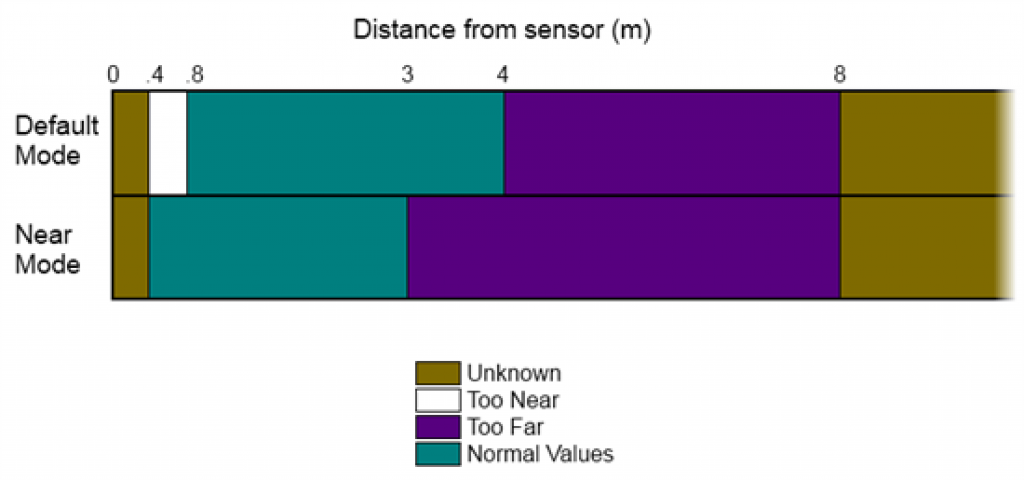
The lenses on the Kinect for Windows sensor are the same as the Kinect for Xbox 360 sensor, so near mode does not change the field of view as some people have been speculating. As some have observed, the Kinect for Xbox 360 sensor was already technically capable of seeing down 50 centimeters – but with the caveat “as long as the light is right”. That caveat turned out to be a pretty big caveat. The Kinect for Windows team spent many months developing a way to overcome this so the sensor would properly detect close up objects in more general lighting conditions.
This resulted not only in the need for new firmware, but changes to the way the devices are tested on the manufacturing line. In addition to allowing the sensor to see objects as close as 40 centimeters, these changes make the sensor less sensitive to more distant objects: when the sensor is in near mode, it has full accuracy and precision for objects 2 meters away, with graceful degradation out to 3 meters. Here is a handy chart one of our engineers made that shows the types of depth values returned by the runtime [editor note: see above graphic]
Check out Eisler's complete writeup for more details, including depth-reporting variances between the current beta runtime code and the planned v1.0 'gold' release, and Microsoft's plans for incremental supporting skeletal tracking over time.
In closing, I'll ask the same question I did two weeks ago; particularly considering that refurb'd units are currently available for well under $100, is it just me or does anyone else also wonder how quickly the hacker community will figure out how to add "near mode" firmware support to Kinect for the Xbox 360?

- ??
- ADAS
- aerospace
- Analog Devices DSP
- analytics
- Android
- Apple
- Apple iPad
- Apple iPhone 4S
- Apple iPhone iPod touch
- Aptina
- Augmented Reality
- Automotive
- Automotive vision
- Autonomous drone
- Autonomous Vehicle
- Autostereoscopic displays
- Azumio
- Barcode
- Baseball
- Biometrics
- Blackfin Embedded Vision Starter Kit Hands-on Workshop
- blur
- Boston Image Processing and Computer Vision Group
- Camera design
- cameraphone
- Carnegie Mellon
- CCD
- CES
- CEVA
- CMOS
- CogniMem
- Comic
- Computational Photography
- computer vision
- Contamination detection
- De-warping
- Design News
- DESIGN West
- Disney
- Driver assistance
- driver information
- embedded vision
- embedded vision alliance
- Embedded Vision Summit
- Embedded vision training
- Embedded Vision Tutorial
- emotion
- emotion detection
- eva
- Evaluation modules
- Eye tracking
- eyeSight
- Face detection
- face recognition
- Facial detection
- Facial recognition
- FiRe
- flying
- Focus
- Foxconn
- games
- gesture
- gesture interface
- Gesture interfaces
- gesture recognition
- GestureTek
- HDR
- health
- High-speed camera
- High-speed capture
- High-speed video camera
- IBM
- IEEE
- IEEE Embedded Vision Workshop
- Image analysis
- Image compression
- Image recognition
- Image sensor
- image sensors
- Image Sensors 2013
- IMS Research
- Industrial vision
- Intel Gesture Interface Facial Recognition
- investment
- iOS
- iPad
- Jitendra Malik
- Kinect
- Kinect Optical Scanner Robotics
- Kodak
- Light intensity detection
- Linley Group
- Lytro
- Mac OS X
- medical
- Medical imaging
- microsoft
- Microsoft Kinect
- military
- mobile
- Motion
- Motion Capture
- Move
- National Instruments
- Neural networks
- New members
- Newsletter
- Nokia
- Nvidia
- NVIDIA Android
- nViso
- object tracking
- object video
- open source
- OpenCV SimpleCV Python C C++
- OpenNI
- optical character recognition
- Optical flow
- Organic Motion
- panel
- Panorama mode
- Parking analytics
- patent
- pc
- PlayStation
- PlayStation Move
- PointGrab
- presentation
- Processors
- pulse
- pulse rate measurement
- Qualcomm
- Raspberry Pi
- Remote control
- Robotics
- robots
- rolling shutter
- Samsung smartphone
- Satellites
- SDK
- search
- security
- slow motion
- Smart TV
- Smartphone
- Soccer
- Sony
- Sports
- Still image analytics
- Surface visualization
- surgery
- Surveillance
- Synopsys
- Tegra 3
- tennis
- Tensilica
- Texas Instruments
- Thermal imaging
- TI
- traffic control
- traffic lights
- user interface
- VanGogh Imaging
- videantis
- video analytics
- Video editing
- Video surveillance
- Videoconferencing
- VideoSurf
- Virtual shopping
- Vision
- Vision Research Phantom
- Volvo
- Webcast
- Website
- x86
- Xbox 360
- xkcd


